You know you need to address UV radiation as a workplace hazard. The question is: what's the most effective and cost-efficient way to meet your duty of care? This business case gives you the data, compliance context, and financial comparison you need to make an informed decision and to present it to your leadership team. We've done the research so you don't have to. Download the full business case, share it with your leadership team, and let the numbers make the argument.
The Case for Action: Meeting Your WHS Obligations
Under Australian WHS legislation, UV radiation is recognised as an occupational hazard for outdoor workers. Employers are legally obligated to protect workers by identifying UV-related risks and introducing control measures, including education and early detection initiatives. A proper program ensures compliance while minimising lost productivity, compensation claims, and healthcare costs.
Australia has one of the highest rates of skin cancer in the world
Outdoor workers receive 5 to 10 times more UV exposure than indoor workers
An estimated 2000 melanomas and 34,000 other skin cancers diagnosed each year result from workplace UV exposure
Skin cancer is the most common and preventable cancer in Australia
Demonstrating Due Diligence
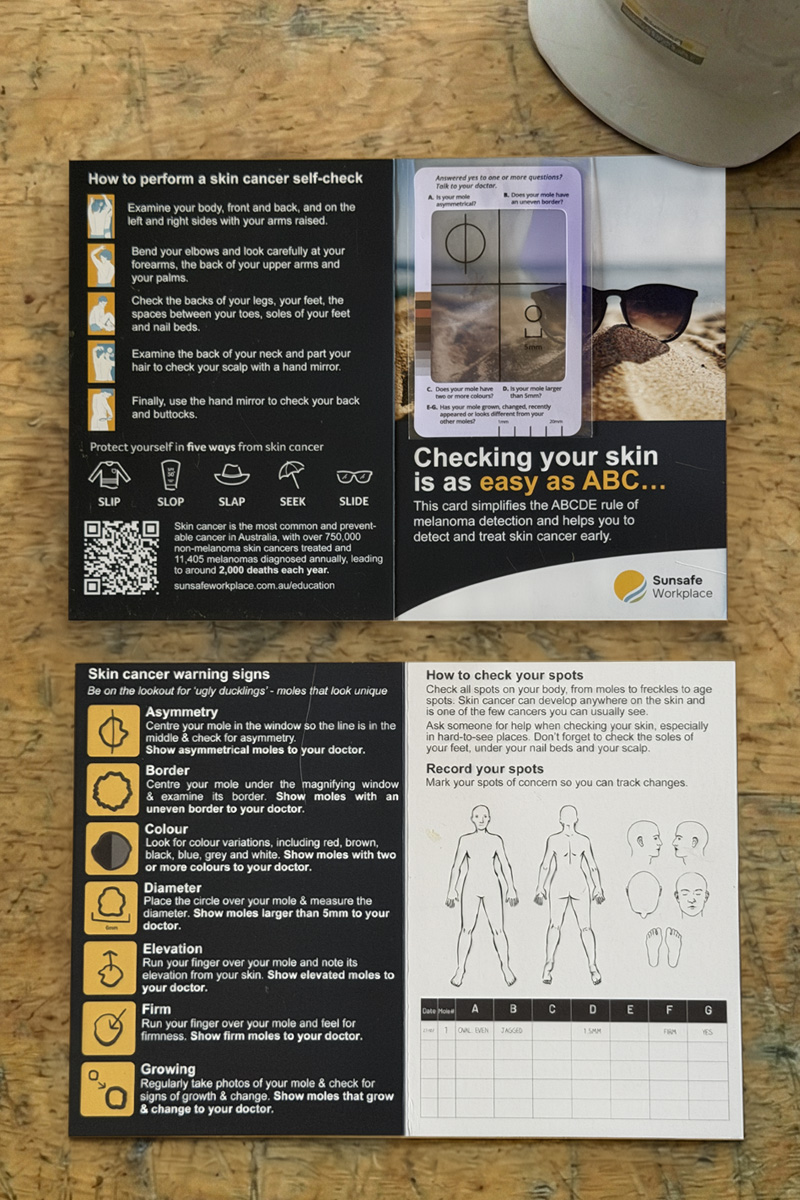
By adopting the Sunsafe Workplace program, your organisation meets its duty of care obligations under WHS regulations regarding UV exposure. The program follows best practices outlined by Safe Work Australia, so all workers receive the necessary education on UV risks and self-detection techniques. Skin Check Cards and the Launchpack give you a clear audit trail showing you've taken every reasonably practicable step to protect your team from a known workplace hazard.
Recorded training sessions (using our Toolbox Talk Video)
Distribution records for Skin Check Cards
Educational material provision (Launch Pack contents)
Ongoing communication (pre and post-launch emails)
What you'll likely find in your workforce
85% of people with a skin spot of concern have not had a skin check by a doctor in the last twelve months. Without education and prompting, these conditions go undetected until they become serious or fatal. Based on nearly two decades of running onsite skin checks, we know what to expect in a typical outdoor workforce.
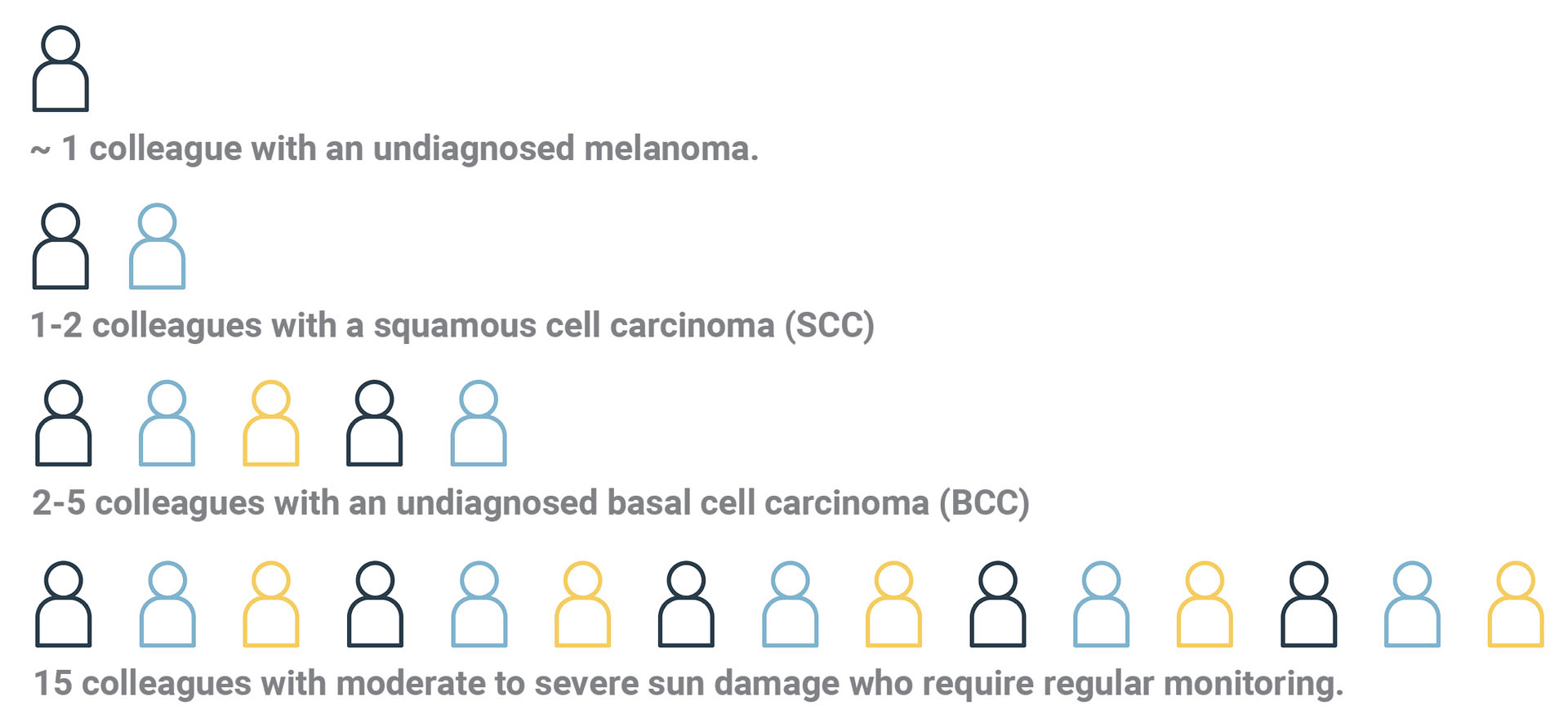
For every 100 employees:
~1 colleague with undiagnosed melanoma
1–2 colleagues with squamous cell carcinoma
2–5 colleagues with basal cell carcinoma
~15 colleagues with moderate to severe sun damage requiring regular monitoring
Cost Comparison: Onsite Skin Checks vs Education Programs
Traditional onsite skin checks serve a purpose, but they come with significant costs and logistical challenges that limit how many of your workers they actually reach.
Onsite Clinics
Sunsafe Workplace
Per employee fee
$60–$100
$4.95–$9.95
Additional travel and accommodation
Flights, car hire, accommodation and per diems for the clinical team
None
Employees covered per day
Up to 45 staff per day
Unlimited
Coordination time
At least one staff member required on-site
Minimal — delivered during regular toolbox talks
Lost productivity
Significant during clinic days
None — delivered during regular OHS meetings
Scalability
Costs increase with more employees
Linear, predictable cost per employee
The 90% cost saving
At $4.95–$9.95 per person, you're looking at a 90% saving per staff member compared to traditional onsite skin checks. For a company with 500 employees:
Onsite Clinics:
Direct cost: $50,000 Indirect cost: $15,000–$25,000 Total estimated cost: $65,000–$75,000
Sunsafe Workplace:
Direct cost: $2,500–$5,000 Estimated savings: $65,000–$70,000
Alignment with Cancer Council recommendations
Cancer Council Australia recommends that employers focus on education and the importance of early detection over skin cancer screening programs. Why?
Early diagnosis relies heavily on early detection through self-examination
The majority of melanomas are detected by patients themselves or their partners
Melanomas detected by doctors tend to be thinner (earlier stage), but most aren't found in clinics
The Sunsafe Workplace program follows these recommendations by giving employees the knowledge and tools for ongoing self-assessment, not just a once-a-year clinical examination
Scalable across sites and shifts
One of the biggest limitations of onsite skin checks is reach. Scheduling examinations across multiple shifts, locations, and employment types is logistically difficult, and often impossible. The Sunsafe Workplace program gives all employees consistent education and access to screening tools, regardless of:
Shift patterns (day, night, rotating)
Employment type (permanent, casual, contract)
Location (metro, regional, remote)
Work arrangements (office, field, work-from-home)
What to do next
Download the business case to share with your leadership team. If you'd like to see the product firsthand, request a free sample pack. Ready to get pricing for your team? Request a quote.
Everything you need to succeed
Our platform provides all the tools and features you need to streamline your workflow and boost productivity.
Lower costs: $4.95–$9.95 per person vs $60–$100 for onsite skin checks
Educational focus: Workers and their families learn to self-monitor and seek medical attention early when they detect spots of concern
Cancer Council aligned: Follows recommended best practice for workplace sun safety
Scalable solution: Reaches every shift and location in your organisation
Logistical ease: No external vendors or complicated scheduling
Proven model: Adopted by 250,000+ workers across Australia's leading companies